

VITA - AI-Powered Teaching for VET
The course helps vocational education and training (VET) teachers understand and use artificial intelligence in a confident, practical, and pedagogically meaningful way.
A kurzusról
The course consists of 5 training modules and an itroductory one (optional) about how AI can improve teaching, learning, assessment, and professional development in ways that are relevant to vocational subjects and future labour-market needs. It also helps teachers guide students toward the conscious and effective use of AI, teaching them to identify its potential and pitfalls.
Tartalomjegyzék
1 Introduction to Main Concepts of Artificial Intelligence
The aim of the module is to introduce teachers to the basic concepts of artificial intelligence and to demonstrate its connection to the work of teachers. It provides an overview of the evolution of AI – from machine learning to generative solutions – and explores its opportunities and limitations. The module supports teachers to confidently evaluate AI-generated responses, select the appropriate tools, and consciously link them to their pedagogical goals, learner needs, and ethical considerations.
- Topic0 - Myths and misconceptions surrounding Artificial Intelligence
- Topic1 - Fundamentals of AI & Modern AI Ecosystem
- Topic2 - Advanced AI tools
- Topic3 - Ethical, legal, and safe use of AI
1.1 Myths and misconceptions surrounding Artificial Intelligence
1.2 Main concept
1.3 Fundamentals of AI & Modern AI Ecosystem
- M1-T1-MLC1 - Machine Learning
- M1-T1-MLC2 - Deep Learning – Neural Networks
- M1-T1-MLC3 - What Is an LLM? How Language Models Generate Text – and Why They Hallucinate
- M1-T1-MLC4 - Clear Context and Structured Questioning Techniques (Prompting)
- M1-T1-MLC5 - Context windows, memory modules and what they mean for education
2 Artificial Intelligence in the Economic Sectors
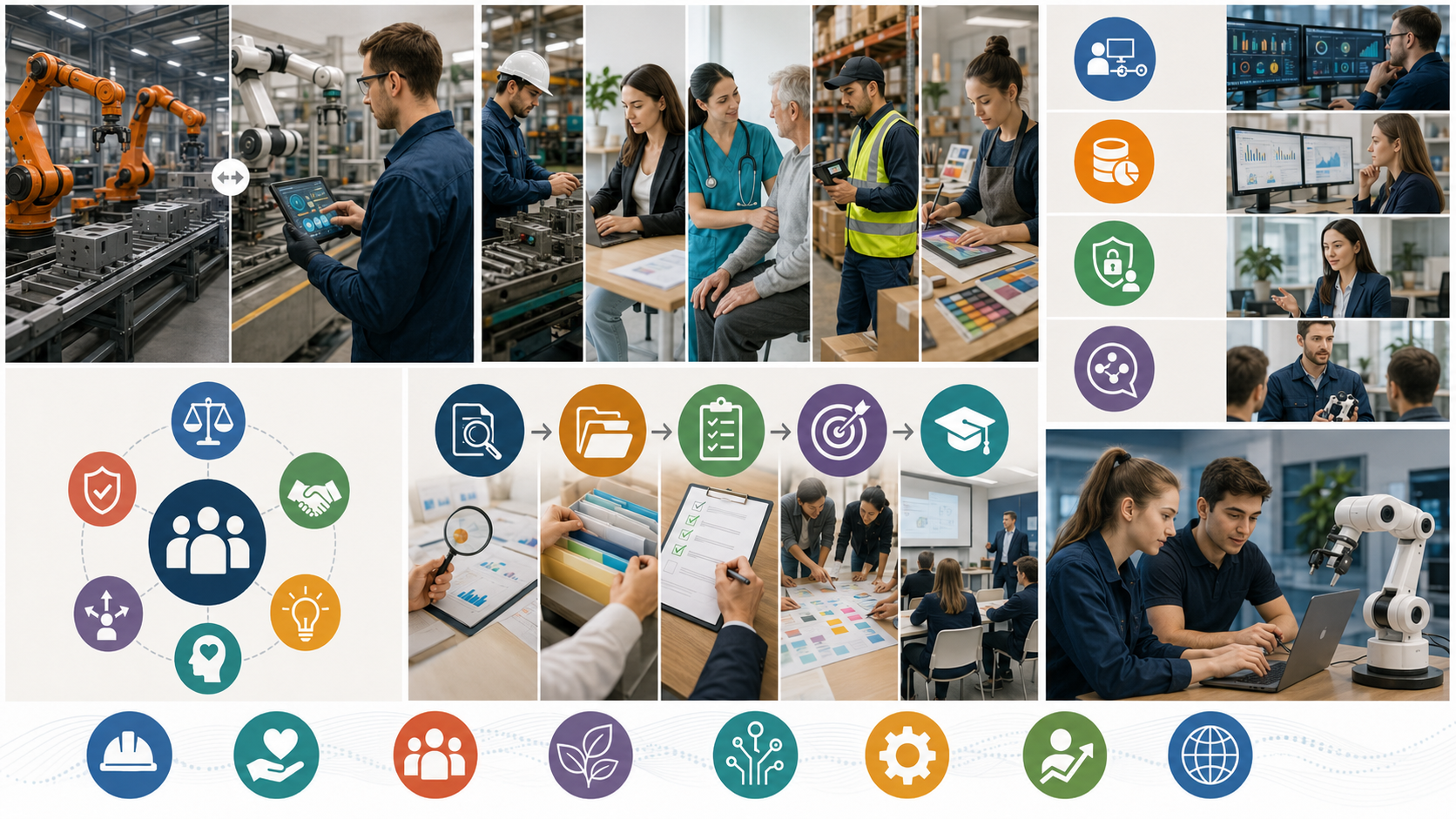
The module presents how artificial intelligence is changing the world of work, what automation is resulting in, what its significance is in supporting professional work, how roles evolve, and what skills gaps need to be filled by skilled workers. It outlines the current situation through eight sector specific areas, highlighting the topics that can be incorporated into education.
- Topic1 - Cross-sectoral overview of how AI transforms professions
- Topic2 - AI in the economic sectors
2.1 Cross-sectoral overview of how AI transforms professions
2.2 AI in the economic sectors
3 Students’ Learning by Artificial Intelligence
This module focuses on pedagogically meaningful ways of how AI can strengthen learning – especially through personalized pathways, adaptive assessment, multilingual support, and careful use of AI tutors (including risks). It also emphasizes active learning and transversal competences such as critical thinking, creativity, collaboration, communication, and inclusion/accessibility via assistive technologies and translation support.
- Topic1 - Personalized and adaptive learning powered by AI
- Topic2 - Developing transversal skills (4Cs) with AI
- Topic3 - Inclusion and accessibility in AI supported learning
3.1 Developing transversal skills (4Cs) with AI
3.2 Inclusion and accessibility in AI supported learning
4 Enhance teaching practice by Artificial Intelligence
This module aims to equip teachers with practical and pedagogically meaningful ways to use AI to support and enhance their everyday teaching practice. It focuses on how AI can assist with lesson planning, content creation, formative assessment, classroom management, reflective teaching, and multimodal learning design. It helps teachers use AI critically, creatively, and responsibly to improve the quality, efficiency, and inclusiveness of teaching while maintaining pedagogical control.
4.1 AI for lesson planning and content creation
4.2 AI-supported formative assessment
5 Artificial Intelligence in Teachers’ Continuous Professional Development (CPD)
The module shows how AI can become a powerful tool for teachers' continuous professional development. It highlights how AI can support learning, professional cooperation, knowledge expansion and pedagogical planning. The module will also help teachers understand the transformation of the role of the teacher and the changes in teacher identity, well-being and autonomy in the era of AI. It aims to enable participants to use AI not only as a practical tool, but also as an important resource for sustainable, ethical and self-directed professional learning.
5.1 Artificial intelligence as an assistant of the teacher
Cél
To help VET teachers to deepen their understanding of AI and empower them to integrate it in their classes in a conscious, critical, safe and ethical way in order to achieve their pedagogical aims and to encourage their learners to use AI critically for their learning.
Értékelés
By the end of the course, participants complete two assignments:
1. They develop an individual concept (strategy) for how they plan to integrate the presented tools and opportunities into their professional and pedagogical work.
2. On the DMC online platform, they prepare a lesson plan for their own subject in which artificial intelligence plays a role in lesson preparation, learning-content development, or classroom work. The submitted assignments are assessed by the course leader together with the mentor, with personalised formative feedback.
Értékelés módja: Szöveges értékelés
Tanúsítvány
Tanúsítvány
Oktatók

Hartyányi Mária
KurzusvezetőPrompt